
| Style | Zone-based reversal or continuation |
|---|---|
| Markets | FX, gold, crypto |
| Timeframes | 15-minute to Daily (Intraday · Swing · Position) |
| Apex Edge tools | Zone Map · Hourly Zones · Imbalance Zones |
Core idea
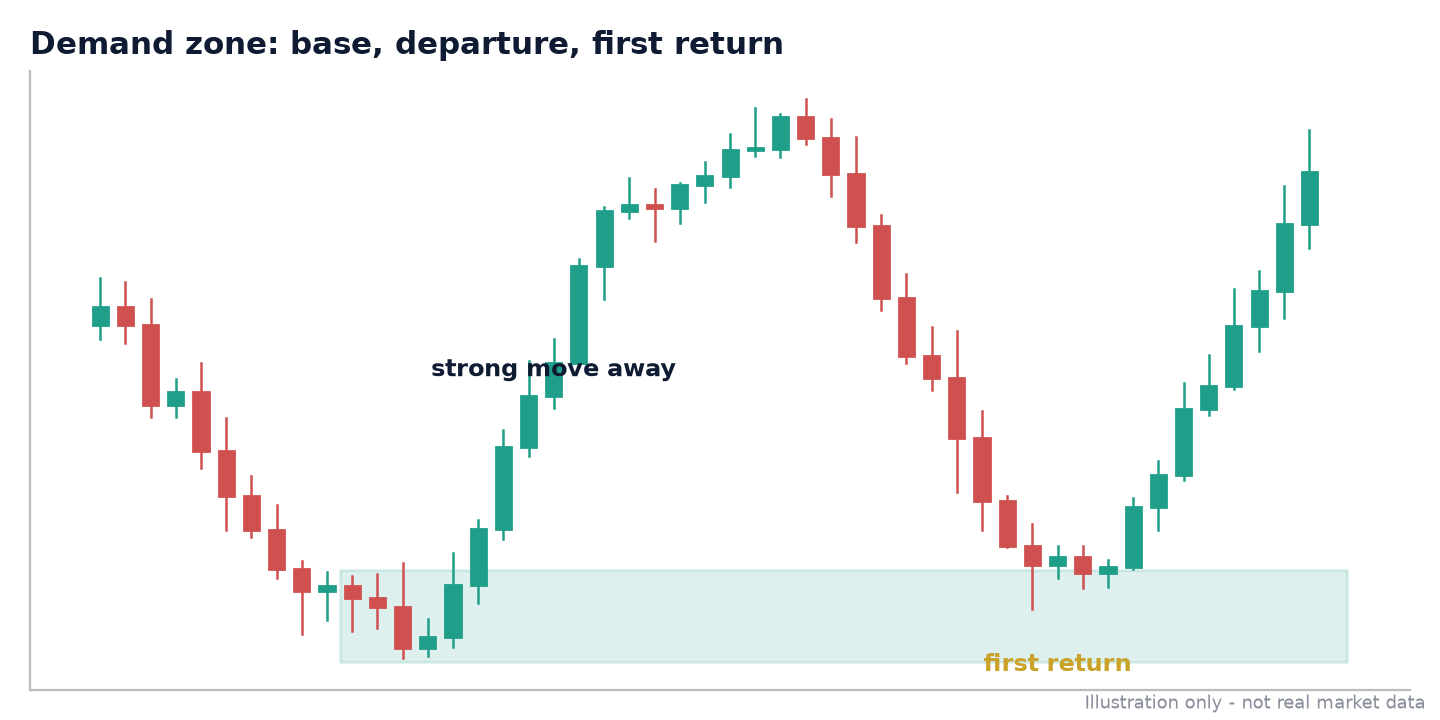
A sharp move away from a small base suggests unfilled orders were left at that base. When price returns, those orders may cause a reaction. Zones are drawn around the base, not at a single price.
Setup rules
- Entry: Mark the base candles before a strong departure. On the first return, look for a rejection candle inside the zone.
- Stop: Beyond the far edge of the zone with an ATR buffer.
- Exit: The opposing zone or a 2R to 3R target.
Best markets and timeframes
All liquid markets; higher-timeframe zones carry more weight.
Common mistakes
- Marking too many zones until every price is "in a zone".
- Trading the third or fourth return as if it were the first.
How Apex Edge indicators help
Zone Map keeps the chart uncluttered with one resistance and one support zone from the latest confirmed swings, sized by ATR, with a count of how many of the last 200 candles traded inside each zone. A low count is closer to the "fresh zone" idea; a high count shows a heavily tested area. Hourly Zones draws 1-hour zones on 5- and 15-minute charts. Imbalance Zones highlights the gaps that strong departures leave behind. None of these tools decide whether a base is "supply" or "demand"; they mark swing-based and gap-based areas for you to judge.
Tested on IC Markets XAUUSD data only. Results may differ on other brokers' price feeds, symbols and timeframes.
Origin and where it is documented
The concept rests on the law of supply and demand that Richard Wyckoff placed at the centre of his method in the 1930s. The modern "zone" version was popularised by Sam Seiden through Online Trading Academy education. The Apex Edge guide "How to Draw Supply and Demand Zones" covers a practical, rules-based approach.
Markets this strategy is listed for
Related price action and structure strategies
- Break of Structure Continuation (Scalp · Intraday · Swing · Position)
- Change of Character Reversal (Scalp · Intraday · Swing · Position)
- Order Blocks (Scalp · Intraday · Swing)
- Fair Value Gaps (Scalp · Intraday · Swing · Position)
- Liquidity Sweep Reversal (Scalp · Intraday · Swing)
Related guides
- Support and resistance zone strategy (full guide)
- EMA trend filter: slope, stack and pullbacks
- Support and resistance zones with ATR
Find every strategy for your market
Pick what you trade and your timeframe, and the free Strategy Finder lists every setup that fits, with the rules and the tools that help. Add your email to download the full 100-strategy ebook as a PDF.
Open the Strategy FinderBrowse all 100 strategiesEducation only. Not financial advice. Trading involves risk of loss. Strategy descriptions are general education, not a recommendation to trade. Rules and examples describe how traders commonly apply each method. They are not a record of results.